
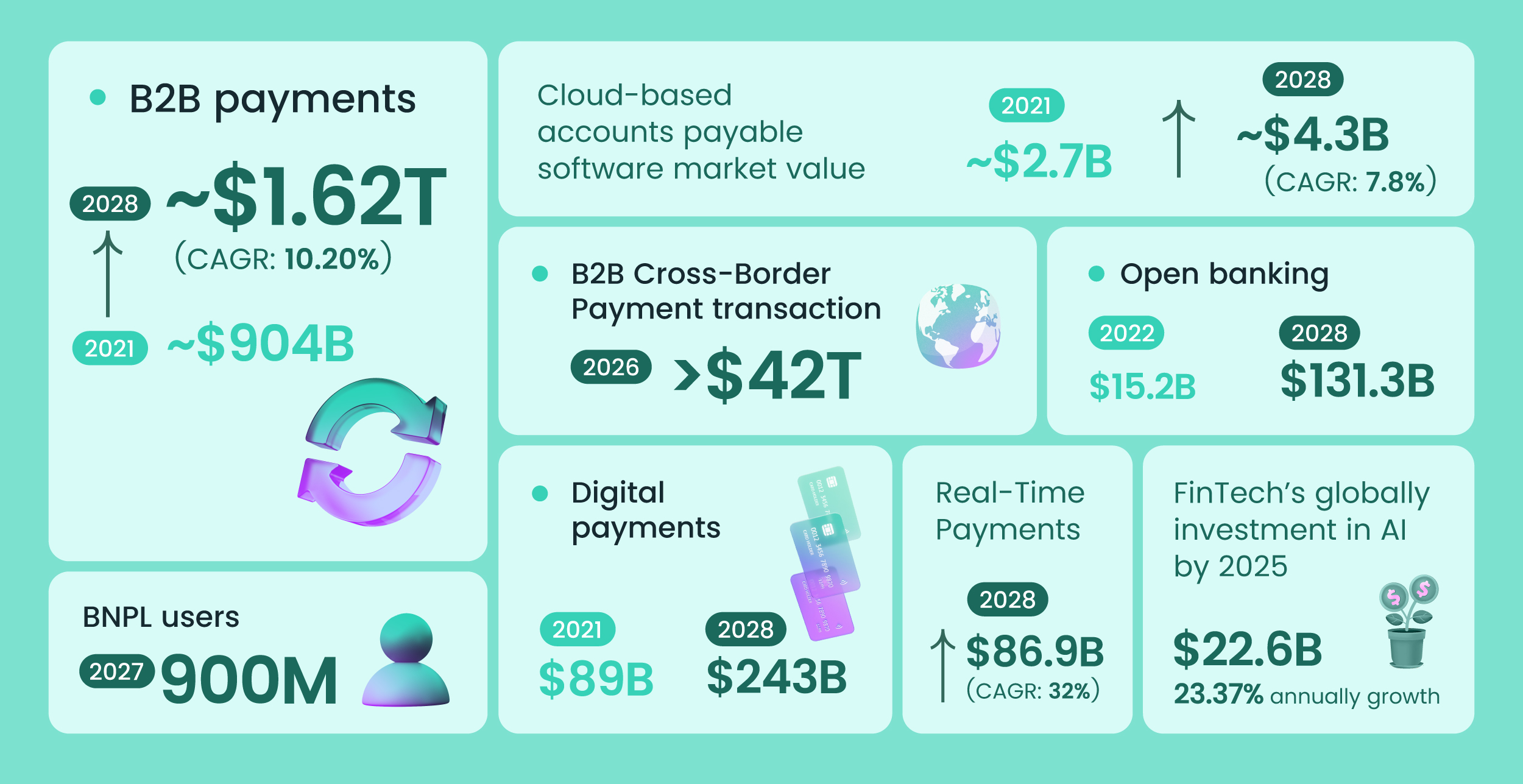
The 2026 shift to real-time settlement
By 2026, the operational baseline for B2B payment automation has moved decisively beyond the legacy constraints of traditional ACH and wire transfers. Finance departments are no longer accepting multi-day settlement cycles as an inherent cost of doing business. Instead, the integration of stablecoins and real-time payment rails has established a new standard for instant settlement, fundamentally altering cash flow dynamics and working capital management.
This transition addresses the persistent latency and reconciliation friction inherent in legacy banking infrastructure. While ACH transfers typically require one to three business days to clear, and international wires often involve intermediary banks and opaque fees, modern B2B payment automation leverages blockchain-based stablecoins and centralized bank APIs to execute near-instantaneous value transfer. This shift is not merely a technological upgrade but a structural change in how liquidity is managed across supply chains.
The adoption of real-time settlement mechanisms allows organizations to reduce Days Sales Outstanding (DSO) significantly. By enabling immediate confirmation of payment receipt, companies can accelerate their cash conversion cycles and mitigate counterparty risk. This operational efficiency is supported by emerging industry analyses, including predictions from TreviPay and Paystand, which highlight embedded finance and AI-driven credit as critical components of the 2026 payment landscape [1, 2]. As regulatory frameworks continue to evolve to accommodate these digital assets, the focus remains on achieving transparency, speed, and compliance in high-stakes financial transactions.
How AI Reduces Days Sales Outstanding
Artificial intelligence transforms the invoice-to-cash cycle by automating the matching of incoming payments to open invoices, a process that directly compresses days sales outstanding (DSO). In traditional B2B workflows, manual reconciliation creates bottlenecks, allowing invoices to linger in accounts receivable for weeks. AI-driven systems resolve these discrepancies automatically, shifting the operational focus from hunting for missing data to confirming matched transactions.
The technology employs machine learning algorithms to analyze payment remittances, purchase orders, and delivery receipts simultaneously. When a payment is received, the system cross-references multiple data points to identify the correct invoice without human intervention. This automation eliminates the lag time associated with manual entry and error correction, ensuring that cash application occurs in near real-time.
Exception handling is another critical area where AI impacts DSO. When a payment does not match an invoice perfectly—due to partial payments, deductions, or coding errors—AI routes these items to the appropriate finance team member with context and suggested resolutions. This targeted routing reduces the time finance professionals spend investigating issues, allowing them to resolve exceptions faster and keep the cash flow moving.
By reducing the administrative burden on accounts receivable teams, AI allows organizations to scale their collections efforts without increasing headcount. The result is a more efficient cash collection process that minimizes the risk of overdue invoices and improves overall liquidity. For high-stakes financial decisions, this operational efficiency provides a measurable advantage in maintaining healthy working capital.
Stablecoin Escrow for Cross-Border Trust
In 2026, stablecoin escrow mechanisms have emerged as a primary tool for mitigating counterparty risk in B2B cross-border transactions. Unlike traditional letters of credit, which rely on slow, manual bank verification, smart contract-based escrow automates the release of funds based on predefined, immutable conditions. This shift reduces the time capital is tied up in transit and minimizes the operational friction associated with multi-jurisdictional compliance.
The process typically follows a sequential workflow. An invoice is generated and locked in a smart contract. Funds are transferred to the escrow address, removing them from the buyer’s immediate control. Upon delivery confirmation—often verified through digital documentation or IoT data—the contract automatically releases the stablecoins to the supplier. This structure ensures that neither party can default without triggering a visible, automated penalty or refund.
Regulatory frameworks in major jurisdictions are beginning to recognize these automated escrows as valid settlement instruments. However, the legal enforceability of code-based conditions remains a nuanced area of financial law. Organizations adopting this technology must ensure that their smart contracts align with local consumer protection and anti-money laundering standards. The trend indicates a move toward hybrid systems where legal contracts and code coexist, providing both technological speed and regulatory clarity.
As noted in recent industry analyses, the integration of AI-driven credit scoring with stablecoin escrow is further refining risk assessment, allowing for dynamic terms that adjust in real-time based on transaction history and market conditions. This evolution supports a more resilient and transparent global trade infrastructure.
B2B fraud prevention with virtual cards
Virtual cards and AI monitoring have emerged as primary fraud prevention tools in 2026, offering finance teams greater control than traditional ACH methods. According to industry analysis from UATP, using virtual cards for merchant-to-supplier payments provides more advanced fraud protection and automation capabilities than traditional ACH or account-to-account transfers [1]. This shift reflects a broader move toward real-time transaction visibility and dynamic controls.
AI-driven monitoring systems now analyze payment patterns continuously, flagging anomalies before funds are transferred. These systems integrate with virtual card networks to enforce spending limits, restrict merchant categories, and expire card numbers after single use. The combination of AI detection and virtual card flexibility reduces exposure to invoice fraud and business email compromise (BEC), which remain significant threats in B2B environments.
While ACH remains common for recurring payments, its slower settlement times and limited ability to revoke transactions make it less suitable for high-risk or one-time supplier engagements. Virtual cards, by contrast, allow finance teams to issue unique, trackable credentials for each transaction, creating an audit trail that simplifies reconciliation and dispute resolution. As AI tools become more sophisticated, the integration of these technologies into payment platforms is expected to further reduce fraud losses and improve operational efficiency for B2B organizations.
[1] UATP, "Making B2B Payments Work Smarter in 2026," November 2025.
2026 Compliance and Regulatory Landscape
The regulatory environment for B2B payment automation in 2026 has shifted from exploratory guidance to strict enforcement, particularly for platforms integrating stablecoins and cross-border data flows. Finance leaders must navigate a fragmented global framework where traditional anti-money laundering (AML) standards intersect with emerging digital asset regulations. The integration of automated invoicing with crypto-enabled settlements requires rigorous adherence to Know Your Customer (KYC) protocols that satisfy both local financial authorities and international banking partners.
Cross-border data flows remain a primary compliance hurdle. As payment automation platforms process transactions across jurisdictions, they must comply with varying data residency laws and reporting requirements. The European Union’s Markets in Crypto-Assets (MiCA) regulation and similar frameworks in Asia mandate transparent transaction histories and real-time reporting capabilities. Organizations must ensure their automation infrastructure can generate audit trails that satisfy these diverse regulatory demands without disrupting payment velocity.
KYC and AML screening for digital assets now require more than static identity verification. Regulatory bodies expect continuous monitoring of transaction patterns to detect potential structuring or layering. Automated systems must integrate real-time screening against global sanctions lists and flag anomalies in B2B payment chains. This shift demands that payment processors provide robust, API-driven compliance tools that allow finance teams to maintain oversight of every transaction node.
To assist in maintaining regulatory alignment, the following checklist outlines the core compliance requirements for 2026 B2B payment automation:
-
Implement continuous KYC verification for all B2B counterparties
-
Integrate real-time AML screening against global sanctions lists
-
Ensure smart contract audit trails are immutable and accessible for regulatory review
-
Configure jurisdiction-specific tax reporting modules for cross-border stablecoin transactions
The trend toward centralized regulatory oversight means that non-compliance risks are no longer limited to financial penalties but extend to operational shutdowns. Finance professionals must prioritize regulatory technology (RegTech) solutions that offer visibility into compliance status across all payment channels. As the 2026 landscape solidifies, the ability to demonstrate strict adherence to KYC/AML and data flow regulations will become a key differentiator for B2B payment platforms.
No comments yet. Be the first to share your thoughts!